Ceramic Coating Solutions for High-Temperature Food Processing Equipment
Table of Contents
- Overview
- Instant Noodle Manufacturing Process
- Challenges in the Frying Process
- Role of Ceramic Coatings
- Benefits for Food Processing Equipment
- Selecting the Appropriate Coating
- TWC’s Coating Solutions
- Conclusion
Overview
Modern food manufacturing requires stable production, consistent product quality, and efficient equipment maintenance. As production lines become increasingly automated, the performance of equipment surfaces has a direct impact on productivity and product quality.
In high-temperature food processing, equipment parts are repeatedly exposed to heat, cooking oil, food residue, cleaning chemicals, and mechanical contact. Under these demanding conditions, food products may stick to baskets, retainers, trays, guides, and other metal components.
This can cause product damage, residue buildup, frequent cleaning, and production downtime.
One possible solution is to apply a ceramic coating with suitable heat resistance, anti-stick performance, slipperiness, surface hardness, and wear resistance. By selecting an appropriate coating according to the operating environment, food manufacturers may improve equipment performance, cleanability, and production efficiency.
The instant noodle frying process is a typical example of a high-temperature food manufacturing application in which surface coating technology can provide significant benefits.
Instant Noodle Manufacturing Process
Although the exact process differs depending on the manufacturer and product type, instant noodle production can generally be divided into the following main steps.
1. Mixing of Ingredients
Wheat flour, water, salt, alkaline agents, and other ingredients are measured and mixed to produce a uniform dough.
2. Noodle Making
The dough is kneaded and passed through rollers to form sheets with the required thickness.
3. Cutting and Forming
The dough sheets are cut into noodle strands. Depending on the product, the noodles may also be waved or formed into a specific shape.
4. Steaming
The cut noodles are steamed to gelatinize the starch and partially cook the noodles.
5. Frying
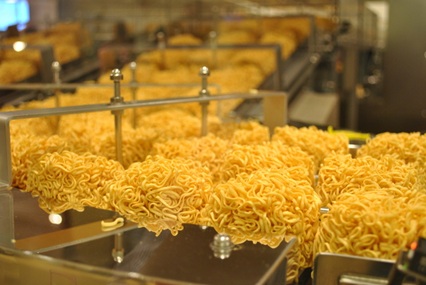
The steamed noodles are placed into baskets or retainers and fried in hot oil. This process removes moisture and gives the noodles their characteristic structure, shape, and storage stability.
Some instant noodles are dried using hot air instead of frying, but oil frying remains a widely used production method.
6. Cooling
After frying, the noodle blocks are cooled to stabilize their shape and temperature before packaging.
7. Packaging
The cooled noodle blocks are inspected and packaged together with soup powder, seasoning oil, or other ingredients.
Challenges in the Frying Process
The frying process is one of the most demanding stages of instant noodle production.
Baskets, retainers, guides, trays, and surrounding equipment components are repeatedly exposed to high temperatures and cooking oil. During continuous production, these parts also come into frequent contact with noodles.
Under these conditions, several problems may occur:
- Noodles may stick to baskets or retainers.
- Noodle blocks may not release smoothly after frying.
- Noodles may be damaged during removal.
- Food and oil residue may accumulate on equipment surfaces.
- Residue may become burnt or carbonized.
- Frequent cleaning may be required.
- Equipment surfaces may gradually wear or deteriorate.
- Production may need to be stopped for maintenance or parts replacement.
When noodles remain attached to a basket or retainer, they may be fried longer than intended or damaged during removal. This can affect their shape, appearance, texture, and overall quality.
Residue that remains on equipment surfaces may also be exposed to repeated heating. Over time, it can become carbonized, making the equipment more difficult to clean and potentially affecting subsequent production cycles.
Role of Ceramic Coatings
A heat-resistant ceramic coating can be applied to suitable metal components used in high-temperature food processing equipment.
The coating forms a functional surface layer over the base material. Depending on the coating specification, it may provide several useful properties:
- High-temperature resistance
- Improved anti-stick performance
- Better slipperiness and product release
- High surface hardness
- Wear resistance
- Corrosion resistance
- Reduced buildup of food residue
- Improved cleanability
In the instant noodle frying process, improved slipperiness and anti-stick performance can help noodle blocks release more smoothly from baskets and retainers.
This may reduce the risk of noodles remaining on the equipment, being fried twice, breaking during removal, or leaving burnt residue that could affect later production cycles.
Ceramic coatings may also create a harder and more durable surface than some conventional coating systems. This can be beneficial for parts exposed to repeated production cycles, mechanical contact, regular cleaning, and high operating temperatures.
However, coating performance depends on many factors, including the coating type, operating temperature, substrate material, surface preparation, equipment design, cleaning method, cleaning chemicals, and mechanical load.
For this reason, the coating must be selected according to the actual production conditions.
Benefits for Food Processing Equipment
Applying an appropriate ceramic coating may provide benefits beyond simple anti-stick performance.
Improved Product Release
A smooth, low-friction surface can help food products release more consistently from baskets, retainers, trays, and other equipment parts.
More Stable Product Quality
Reducing sticking and product damage can help maintain the required shape, appearance, and condition of the finished product.
Reduced Residue Buildup
A suitable coating may reduce the accumulation of food, oil, and burnt residue on equipment surfaces.
Easier Cleaning
Surfaces that retain less residue may require less time and effort to clean.
Reduced Production Downtime
Reducing the frequency of cleaning, maintenance, and parts replacement may allow the production line to operate for longer periods with fewer interruptions.
Longer Component Life
Heat resistance, surface hardness, and wear resistance may help extend the service life of baskets, retainers, guides, trays, and other metal components.
Improved Production Efficiency
Stable product release, easier cleaning, and reduced maintenance can contribute to more efficient and reliable food production.
Selecting the Appropriate Coating
Not every coating is suitable for every food processing environment.
Before selecting a ceramic coating, it is important to review the following conditions:
- Maximum and continuous operating temperatures
- Type of food product or cooking oil
- Substrate material
- Shape and dimensions of the component
- Contact pressure and mechanical load
- Required anti-stick and slipperiness performance
- Cleaning method and cleaning frequency
- Cleaning chemicals used
- Required coating thickness
- Expected service life
- Whether the coated surface directly contacts food
For components that directly contact food, the suitability of the coating for the intended food-contact application must be confirmed separately.
Applicable regulations, customer requirements, production conditions, and coating specifications should be reviewed before use. A trial coating or prototype evaluation may also be recommended before full-scale adoption.
TWC’s Coating Solutions
TWC provides coating solutions for components used in food processing and other high-temperature manufacturing environments.
Based on the customer’s operating conditions, we review the required heat resistance, anti-stick properties, slipperiness, wear resistance, surface hardness, and cleaning requirements.
Possible applications include:
- Instant noodle frying baskets
- Noodle retainers
- Metal trays
- Guides and chutes
- Conveyor components
- Food processing jigs and fixtures
- Heating and drying equipment components
- Other parts exposed to heat, oil, adhesion, or wear
We can also support custom components, coating trials, and prototype development according to the part material, shape, dimensions, and production conditions.
When contacting us, please provide available information such as component drawings, photographs, substrate material, operating temperature, cleaning method, current problems, and required performance.
Conclusion
Ceramic coating technology can play an important role in improving high-temperature food processing equipment.
In the instant noodle frying process, baskets, retainers, and other metal components must operate under high temperatures, continuous contact with cooking oil, repeated production cycles, and regular cleaning.
A properly selected ceramic coating may improve anti-stick performance, slipperiness, heat resistance, wear resistance, durability, and cleanability. It may also help reduce residue buildup, maintenance work, component replacement, and production interruptions.
TWC proposes coating solutions based on the actual operating environment and each customer’s requirements.
Please contact us to discuss ceramic coatings for instant noodle manufacturing equipment or other high-temperature food processing applications.